What starting contact lens parameters does this calculator return?
Starting contact lens parameters are ordered sphere, with cylinder and axis for a toric lens, after vertex, optional spherical equivalent, and 0.25 D rounding.
Starting parameters are the calculator output before trial-lens evaluation: ordered optical values as worn at the corneal plane, not a finished contact lens prescription.
This contact lens converter returns three ordered values:
- Ordered sphere for OD and OS
- Cylinder and axis when a toric lens is intended
- Disclosed vertex distance in millimeters (default 12 mm)
It does not return three fitting values a glasses Rx never contained:
- Base curve of contact lenses
- Diameter of contact lenses
- Material or a manufacturer SKU
Those geometric and material values come from keratometry, topography, slit-lamp assessment, and a trial lens. Converted power is a starting Rx parameter, not a brand picker.
Why does spectacle power differ from contact lens power at the corneal plane?
Spectacle power differs from contact lens power because vertex distance moves the lens from about 12 to 14 mm in front of the cornea to the corneal plane.
Vertex distance is the space between the back surface of a spectacle lens and the front of the cornea. The corneal plane is where a contact lens sits, so contact-lens vertex is essentially zero, and moving the lens in that far changes effective power. That optical shift is why glasses numbers and contact lens numbers diverge.

According to Wikipedia, Vertex distance and the ODReference Vertex Distance Calculator, Fc = Fs ÷ (1 − d × Fs). Fc is corneal-plane power, Fs is spectacle-plane power, and d is vertex distance in meters. For a 12 mm vertex, d equals 0.012.
Formula
Fc = Fs ÷ (1 − d × Fs) with d in meters. Default d = 0.012 when vertex is unspecified, and we disclose that 12 mm assumption in the calculator.
Clinical takeaway
Calculate vertex-compensated contact lens power at the corneal plane before you round or choose spherical equivalent. Isolate vertex when a meridian sits near the clinical gate or the measured back vertex distance is not 12 mm.
This homepage converter gates vertex at ±4.00 D. Isolate the same math on the contact lens vertex calculator and distance chart, which always applies Fc then rounds. Read why the glasses number changes at the cornea when you need the plane change without the calculator.
When does vertex compensation change the ordered sphere?
Vertex compensation becomes clinically important once meridional powers are at or above about ±4.00 D.
The vertex change often stays under a 0.25 D manufacturing step below about ±4.00 D and leaves the ordered sphere alone. Around ±4.00 D the difference becomes more than 0.25 D, per Wikipedia, Vertex distance. The National Academy of Opticianry course Vertex Distance, Effective Power, and Compensated Power, approved by the American Board of Opticianry, puts the same threshold as a rule: for contact lenses, all powers greater than 4.00 D in either principal meridian must be compensated. Apply vertex to each principal meridian on a toric Rx, not to sphere only. We assume 12 mm when you leave vertex blank. Enter the measured back vertex distance when the refraction lists another value.
How do minus and plus spectacle meridians change after vertex?
High minus spectacle meridians convert to less minus ordered contact lens power; high plus meridians convert to more plus.
Minus lenses gain effective power as they move closer to the eye, so the ordered contact lens is often less minus than the glasses Rx. Plus lenses lose effective power at the cornea, so the ordered contact lens is often more plus. Those directions sit inside the same conversion workflow as spherical equivalent and rounding.
Three 12 mm chart rows from the ODReference Vertex Distance Calculator, rounded to the nearest 0.25 D step:
| Spectacle (D) | Starting CL (D) | Change |
|---|---|---|
| −4.00 | −3.75 | +0.25 |
| −6.00 | −5.50 | +0.50 |
| +6.00 | +6.50 | +0.50 |
A −6.00 D spectacle meridian starts near −5.50 D as a contact lens. A +6.00 D meridian starts near +6.50 D. A −4.00 D meridian starts near −3.75 D, at the edge of the clinical gate.
What steps does spectacle to contact lens conversion follow?
Five conversion steps turn a glasses Rx into ordered starting power: enter the refraction as written, then vertex, optional SE, round to 0.25 D, and confirm on eye.
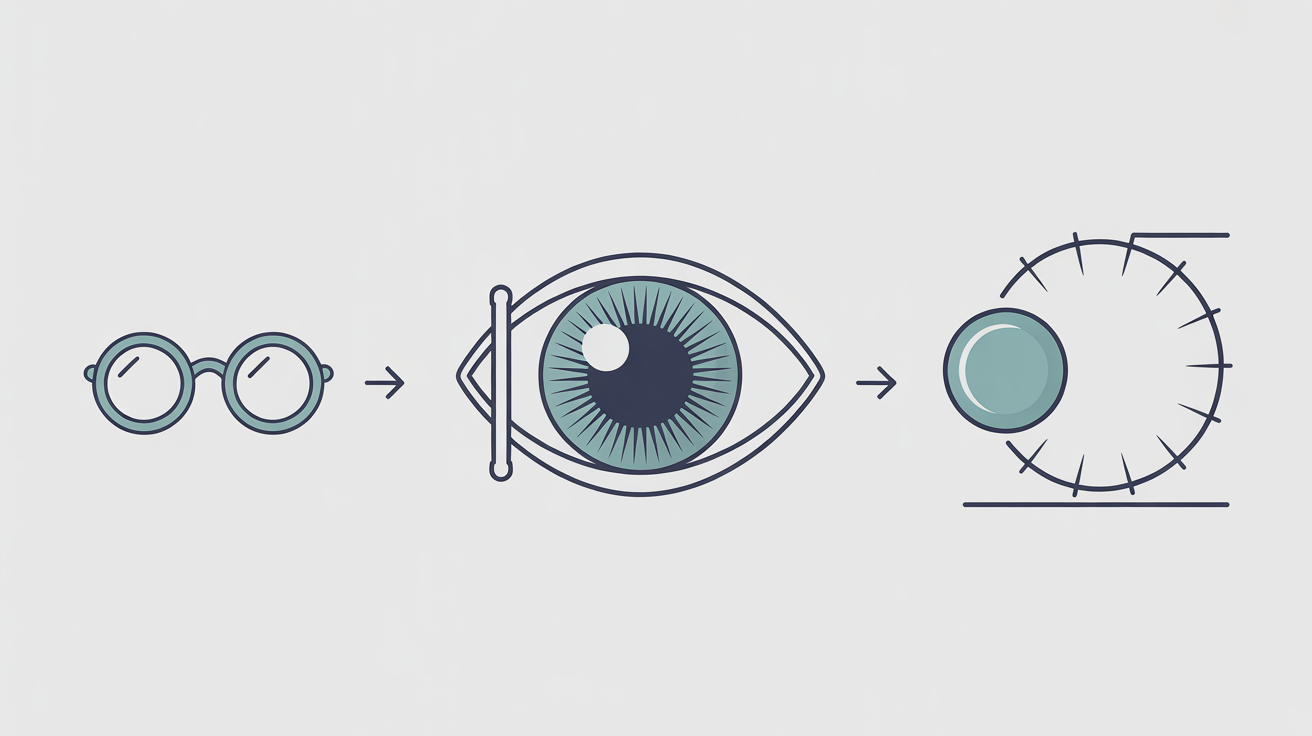
- Enter the spectacle refraction as written for OD and OS, including sphere, cylinder, and axis. Plus-cylinder notation belongs in the plus and minus cylinder transposition calculator before you convert.
- Apply vertex compensation by meridian when meridional power is at or above about ±4.00 D at the spectacle plane.
- Choose a spherical or toric lens. Compute spherical equivalent only after vertex, and only when a spherical lens is intended.
- Round vertex-compensated power to the nearest 0.25 D manufacturing step. Stay manufacturer-agnostic. Do not map the result to a brand SKU grid.
- Confirm fit, comfort, and over-refraction on eye, then adjust ordered power.
That sequence converts a glasses Rx into ordered starting power. Keratometry, trial-lens evaluation, and a licensed fitting still sit after the last step.
Isolate vertex distance when a meridian is high or the vertex you used is not the 12 mm default.
When is spherical equivalent used instead of a toric lens?
Spherical equivalent equals Sphere + (Cylinder ÷ 2) after vertex compensation.
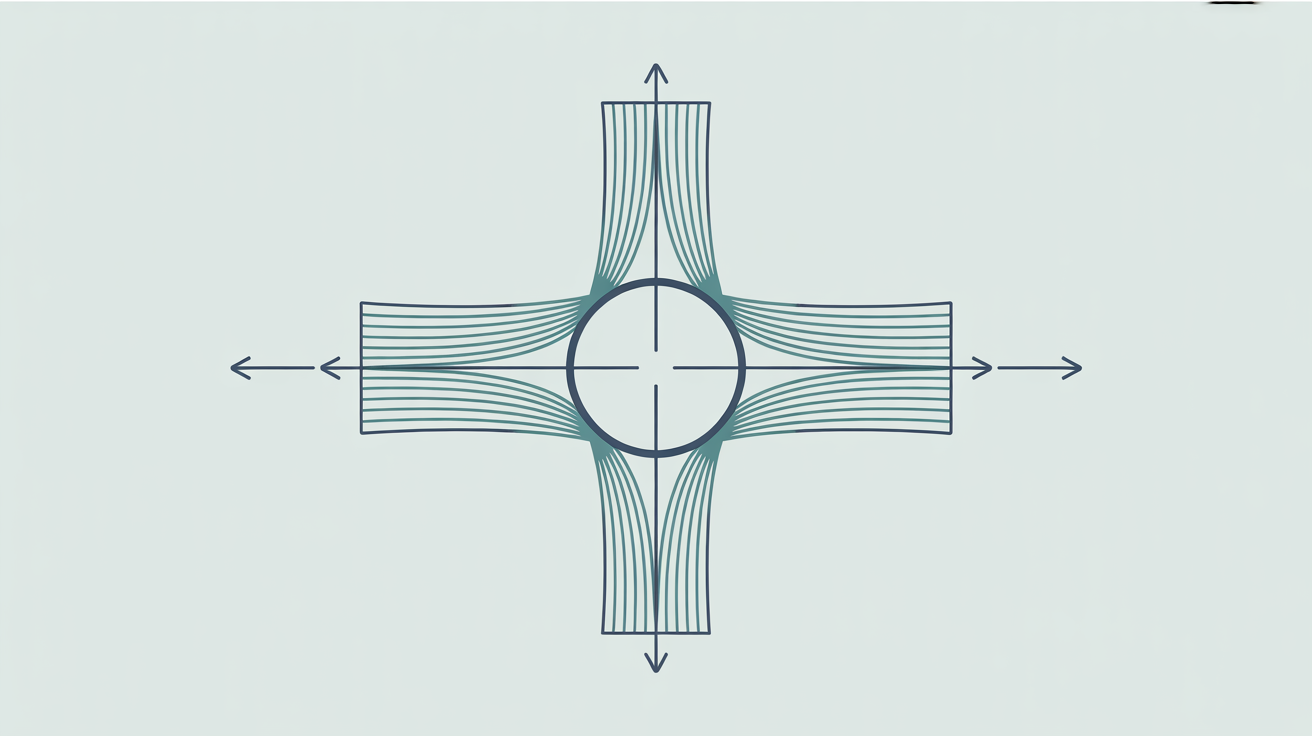
Enaholo, Musa and Zeppieri state the same identity as SE = S + C/2 in the StatPearls chapter The Spherical Equivalent, and name ordering a soft contact lens for a patient with very low or no manifest subjective astigmatism as one of its uses. Use that value only when a spherical soft lens is intended over low, regular astigmatism and residual cylinder is accepted. Spherical equivalent is a clinical compromise. It is not a substitute for indicated toric correction. Apply spherical equivalent after vertex, never before. Calculate a starting toric power instead of collapsing the cylinder when cylinder remains clinically indicated.
The toric contact lens calculator applies vertex to each meridian and keeps indicated cylinder.
Spherical equivalent is one step inside this conversion. When that step is the whole question — the residual cylinder you accept, the order of vertex and SE, the sphere-only number on its own — open thespherical equivalent calculator. It returns the same number this page returns, from the same formula.
How is starting power rounded to manufacturing steps?
Ordered power rounds to the nearest 0.25 D manufacturing step after vertex and any optional spherical equivalent.
That step size is the agnostic increment used on the ODReference Contact Lens Conversion Calculator and the Omni Calculator Contact Lens Vertex Calculator, not a catalog grid and not a manufacturer rule that rounds cylinder down or axis to 10°. Show the rounded starting parameters next to the unrounded vertex result so the 0.25 D jump is visible.
How do you calculate a toric starting power from spectacle cylinder?
To calculate a toric starting power from spectacle cylinder, vertex each principal meridian, then reconstruct SPH, CYL, and axis; axis is unchanged.

Do not replace indicated cylinder with spherical equivalent on this path. Worked example at the 12 mm default: −5.00 −2.00 × 180 splits into meridians of −5.00 D and −7.00 D. Both sit at or above the ±4.00 D gate, so both compensate — to −4.72 D and −6.46 D. Cylinder is the difference, −6.46 − (−4.72) = −1.74 D, and the starting order rounds to −4.75 −1.75 × 180. Axis is unchanged. This page is a contact-lens toric starting-power path, not a Barrett IOL calculator.
Unstable rotation is a fit problem first. Change base curve, diameter, or design before chasing power with over-refraction.
How do you verify starting parameters after the trial lens?
Starting parameters are verified with over-refraction after the trial lens.
Over-refraction is the residual refractive error measured through the trial lens on eye, used to verify power after you convert and calculate.
Verify starting parameters on eye in this order:
- Apply the diagnostic trial lens using the starting parameters.
- Assess centration, movement, and toric rotation before you change power.
- Over-refract through the stable lens.
- Adjust the next ordered power from that over-refraction.
If rotation does not stabilize, change base curve, diameter, or design before optically compensating. Use the over-refraction calculator for contact lens parameters after the trial. Starting contact lens parameters are not a prescription.
Verify with over-refraction after the trial lens.
Does this converter apply the inverse vertex formula?
This calculator converts spectacle power to the corneal plane only. Entering a contact-lens power in the spectacle fields vertices the wrong way.
Wikipedia, Vertex distance publishes the inverse as Fs = Fc ÷ (1 + d × Fc). This calculator does not apply that inverse. A contact-lens power entered as spectacle power here is still treated as Fs in Fc = Fs ÷ (1 − d × Fs). Run the inverse by meridian on the Contact Lens Prescription to Glasses Calculator. That direction recovers a spectacle-plane power only; it is not a glasses prescription, and neither direction restores base curve, diameter, or material.
Look up rounded spectacle-to-contact pairs on the contact lens conversion chart. Use this calculator when you need OD/OS meridians, disclosed vertex, and rounding shown.
Why is a converted power not a contact lens prescription?
Converted power is a starting point; a contact lens prescription also requires base curve, diameter, material, and on-eye confirmation.
Power conversion applies vertex to the spectacle refraction. A full contact lens prescription adds measurements a glasses Rx does not contain. Pinnacle Eyecare, Can You Convert Glasses Prescription to Contact Lenses? names three missing items a chart cannot figure out:
- Base curve matched to corneal shape
- Diameter from edge to edge
- Lens brand and material
Trial-lens evaluation and over-refraction still decide fit, comfort, and final power. This site is manufacturer-agnostic. For brand-locked tools, see contact lens calculators: OptiExpert, Simplifit, and independent tools.
Patient aside (Grade 8–9)
Glasses sit about 12 mm in front of your eyes. Contacts sit on the cornea. That is why the glasses number is not a contact lens prescription. Converted power is a starting number for a licensed fitter. Don't order lenses from this output.
Not a Rx
Not a prescription / on-eye next step
Converted power is not a contact lens prescription. Next step: trial lens on eye, then over-refraction.
Which related calculators isolate vertex, toric, and the conversion chart?
Related calculators isolate the next contact lens parameters after glasses to contacts conversion.
These related tools sit one click from this conversion calculator:
- Contact lens vertex calculator and distance chart
- Toric contact lens calculator
- Contact lens conversion chart
- Contact lens calculators: conversion, vertex, and toric
Convert a spectacle prescription to contact lens parameters here first. Then isolate vertex, calculate a toric starting power, or read the chart. When you need a starting add after distance power is converted, open the multifocal tool. Verify power with over-refraction after the trial lens.
Sources
Each source below is listed against the specific constant it supports. Where a source states a rule this calculator does not follow, that is recorded too. Full derivations are on How we calculate.
- Kollbaum PS, Bradley A, Thibos LN. Comparing the Optical Properties of Soft Contact Lenses On and Off the Eye. Optometry and Vision Science, 2013 (PMID 23969894) — peer-reviewed use of the plane-shift computation, described there as the method "commonly used in the clinical setting to 'vertex' a spectacle prescription to a contact lens prescription", written in reciprocal focal-length form that rearranges to Fc = Fs ÷ (1 − d × Fs). Its own shift is 3 mm, back vertex to pupil plane; only the identity is taken from it.
- Stokkermans TJ, Day SH. Aniseikonia. StatPearls, NCBI Bookshelf — vertex distance "is generally close to 12 mm (0.012 m)", the default this converter discloses when none is entered.
- Enaholo ES, Musa MJ, Zeppieri M. The Spherical Equivalent. StatPearls, NCBI Bookshelf — SE = S + C/2, and ordering a soft contact lens for very low or no manifest subjective astigmatism as an indication for it.
- Drake DF. Vertex Distance, Effective Power, and Compensated Power — Tilt — Wrap. National Academy of Opticianry continuing-education course, approved by the American Board of Opticianry, 2016 — for contact lenses, all powers greater than 4.00 D in either principal meridian must be compensated; a compound Rx is compensated one meridian at a time. Its arithmetic shortcut (EP = D² ÷ 1000 × mm of change) is an approximation this calculator does not use, and its 14 mm spectacle-dispensing default is not the 12 mm contact lens default here.
- Wikipedia, Vertex distance — plain-language statement of Fc = Fs ÷ (1 − d × Fs) and of the inverse Fs = Fc ÷ (1 + d × Fc). Cross-check, not clinical authority; the inverse is run on Contact Lens Prescription to Glasses Calculator, never here.
- ODReference Contact Lens Conversion Calculator and Omni Calculator, Contact Lens Vertex — independent calculators using the same 0.25 D manufacturing step. Named as alternatives and as a numeric cross-check, not as clinical authority.
- Pinnacle Eyecare, Can You Convert Glasses Prescription to Contact Lenses? — practice article naming base curve, diameter and material as the parameters a power conversion cannot produce. Used for that scope statement only.
Published Last updated Report a correction