What is vertex distance in contact lens conversion?
Vertex distance is the space between the back of the spectacle lens and the cornea. A contact lens sits on the cornea, so its vertex is essentially zero.
Spectacle lenses commonly sit about 12 to 14 mm from the cornea, the spectacle plane this calculator converts away from. That plane change is why the glasses number is not the contact lens number. The same dioptric label at 12 mm in front of the eye does not produce the same effective power once the lens rests on the cornea. Vertex compensation converts the spectacle-plane refraction into corneal-plane starting power so the ordered contact lens matches the intended retinal image. Back vertex distance is the measured name for that gap. This page uses it as d in the formula below.
How do you calculate vertex-compensated contact lens power?
Vertex-compensated contact lens power is calculated as Fc = Fs ÷ (1 − d × Fs), with d in meters (0.012 at 12 mm).
Formula
Fc = Fs ÷ (1 − d × Fs)
Fc is corneal-plane (contact lens) power in diopters. Fs is spectacle-plane power in diopters. d is vertex distance in meters. At the 12 mm default, d = 0.012. A contact lens final vertex is 0, so d equals the spectacle vertex you enter.
That identity is not specific to this site. Kollbaum, Bradley and Thibos, in Comparing the Optical Properties of Soft Contact Lenses On and Off the Eye (Optometry and Vision Science, 2013), shift lens power between two planes by the method they describe as the one "commonly used in the clinical setting to 'vertex' a spectacle prescription to a contact lens prescription", written in reciprocal form as F = 1 ÷ (1 ÷ F − d). That is the same identity as Fc = Fs ÷ (1 − d × Fs), rearranged.
The following steps convert a written spectacle power into starting contact lens power.
- Enter the spectacle power as written.
- Set vertex distance in millimeters (default 12).
- Convert d to meters (12 mm = 0.012 m).
- Calculate Fc, then round to the nearest 0.25 D for the manufacturing step.
Those four steps are the contact lens vertex calculator. Sphere-only input is enough for a spherical Rx. A toric Rx still needs both meridians, reconstructed after the same formula. For a non-12 mm refraction, keep the measured millimeters; the algebra does not change.
Clinical takeaway
Calculate Fc at the stated vertex, show unrounded and 0.25 D starting power, then fit on eye. The formula is the chart. The chart is the formula in lookup form.
What does a 12 mm contact lens vertex chart show?
The following tables list starting contact lens power at 12 mm for common spectacle powers from ±4.00 D upward. Each starting value is Fc = Fs ÷ (1 − 0.012 × Fs), rounded to the nearest 0.25 D. Change is rounded starting power minus spectacle power.

| Spectacle power (D) | Starting CL power (D) | Change (D) |
|---|---|---|
| −4.00 | −3.75 | +0.25 |
| −4.50 | −4.25 | +0.25 |
| −5.00 | −4.75 | +0.25 |
| −5.50 | −5.25 | +0.25 |
| −6.00 | −5.50 | +0.50 |
| −6.50 | −6.00 | +0.50 |
| −7.00 | −6.50 | +0.50 |
| −7.50 | −7.00 | +0.50 |
| −8.00 | −7.25 | +0.75 |
| −8.50 | −7.75 | +0.75 |
| −9.00 | −8.00 | +1.00 |
| −9.50 | −8.50 | +1.00 |
| −10.00 | −9.00 | +1.00 |
| −11.00 | −9.75 | +1.25 |
| −12.00 | −10.50 | +1.50 |
| −14.00 | −12.00 | +2.00 |
| −16.00 | −13.50 | +2.50 |
| −18.00 | −14.75 | +3.25 |
| −20.00 | −16.25 | +3.75 |
| Spectacle power (D) | Starting CL power (D) | Change (D) |
|---|---|---|
| +4.00 | +4.25 | +0.25 |
| +4.50 | +4.75 | +0.25 |
| +5.00 | +5.25 | +0.25 |
| +5.50 | +6.00 | +0.50 |
| +6.00 | +6.50 | +0.50 |
| +6.50 | +7.00 | +0.50 |
| +7.00 | +7.75 | +0.75 |
| +7.50 | +8.25 | +0.75 |
| +8.00 | +8.75 | +0.75 |
| +8.50 | +9.50 | +1.00 |
| +9.00 | +10.00 | +1.00 |
| +9.50 | +10.75 | +1.25 |
| +10.00 | +11.25 | +1.25 |
| +11.00 | +12.75 | +1.75 |
| +12.00 | +14.00 | +2.00 |
| +14.00 | +16.75 | +2.75 |
| +16.00 | +19.75 | +3.75 |
Minus spectacle powers lose minus at the cornea after rounding. Plus spectacle powers gain plus. Use the calculator at the top for an unrounded Fc, a vertex other than 12 mm, or a toric pair of meridians. This contact lens vertex chart, written CL vertex chart on most chairside sheets, is a vertex distance calculator chart for contact lens parameters, not a GP diopters-to-radius table.
When does vertex change the ordered sphere?
Vertex compensation becomes clinically meaningful for meridional powers at or above about ±4.00 D.
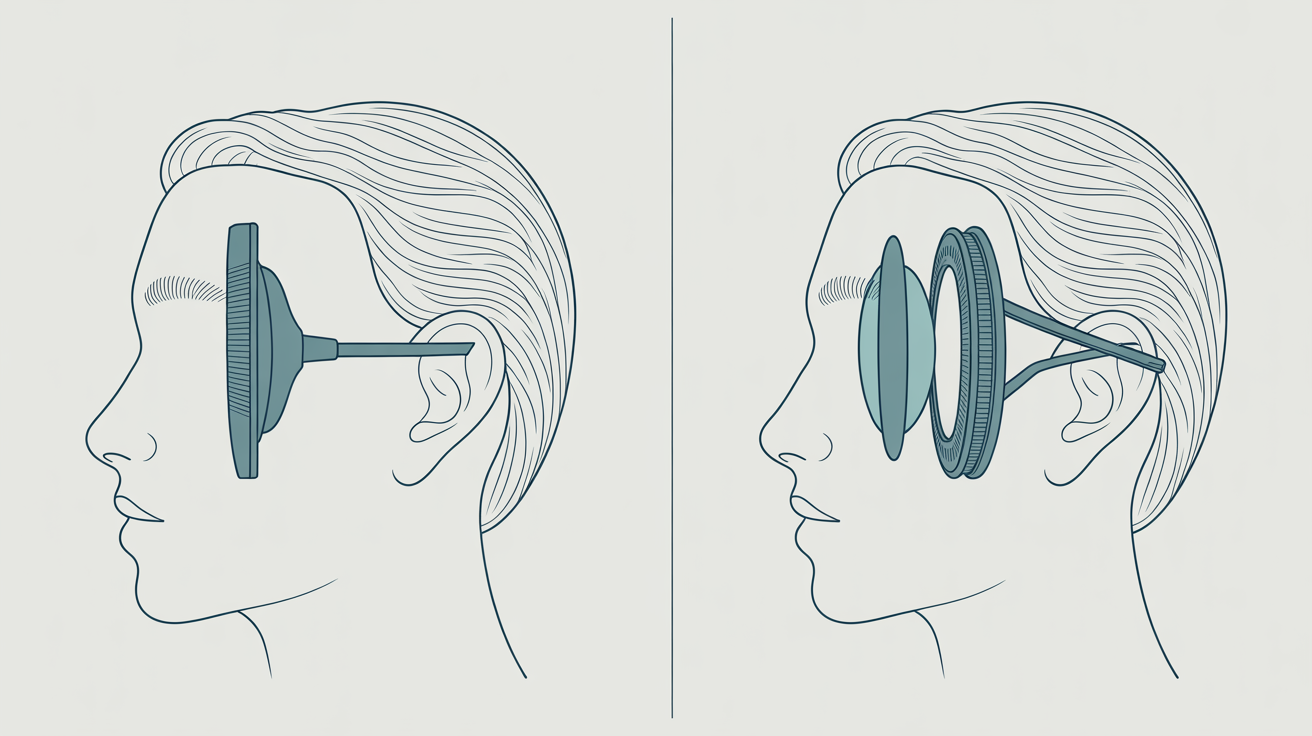
The vertex change often stays under a 0.25 D manufacturing step below about ±4.00 D and leaves the ordered sphere alone. Around 4 D the difference is more than 0.25 D, per Wikipedia, Vertex distance. The National Academy of Opticianry continuing-education course Vertex Distance, Effective Power, and Compensated Power, approved by the American Board of Opticianry, states the same threshold as a rule: for contact lenses, all powers greater than 4.00 D in either principal meridian must be compensated. High myopia, high hyperopia, and anisometropia are the three clinical settings where that difference shows up in acuity or binocular balance; high ametropia of either sign is where the ordered power moves furthest from the written one. Apply the formula to each meridian of a toric Rx, not only to the written sphere. The 12 mm chart starts at ±4.00 D for the same reason: that is where compensation begins to move the ordered power.
This page always applies Fc, then rounds, even below that gate. The homepage converter gates vertex at or above about ±4.00 D, so ±3.75 D at 12 mm can move a 0.25 D step here and not when you convert the rest of the spectacle Rx. That home path also applies rounding and optional spherical equivalent when a spherical lens is intended. Spherical equivalent is not calculated on this vertex page.
How does vertex compensation change minus spectacle power?
Minus spectacle lenses convert to less minus starting contact lens power at the corneal plane.
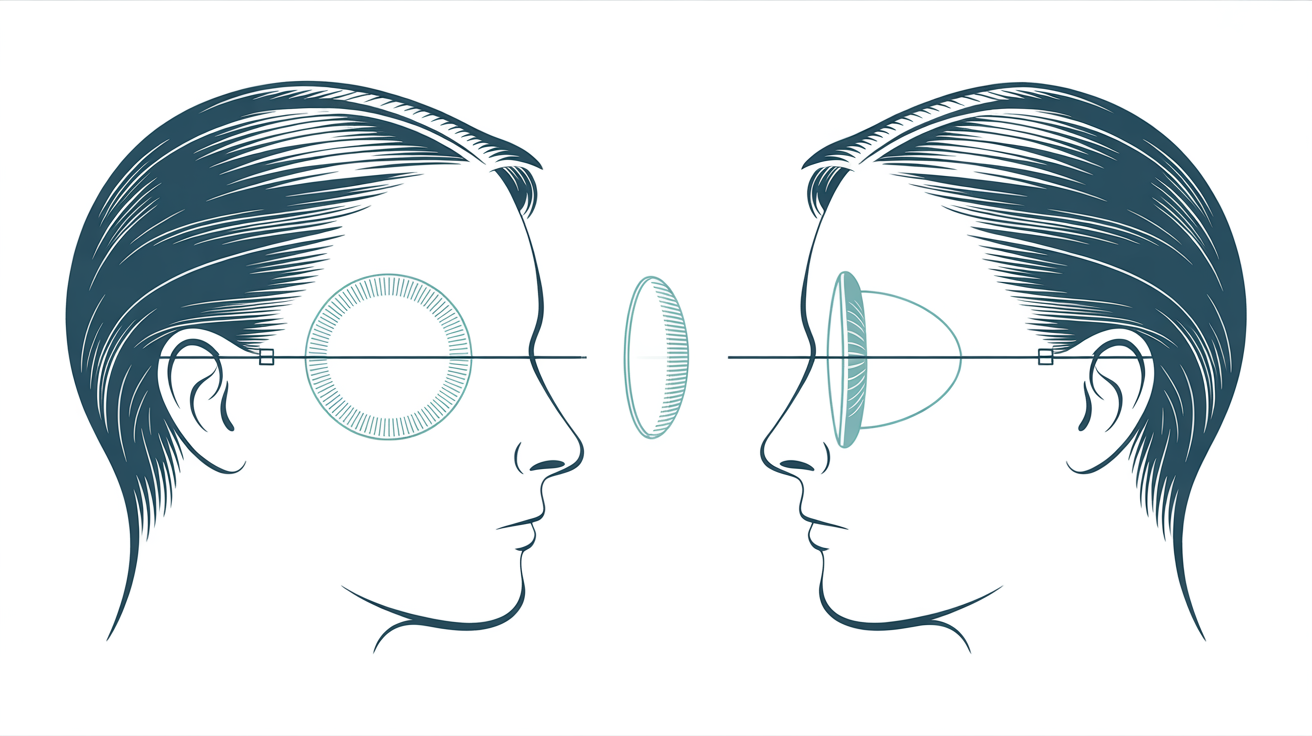
A minus lens gains effective power as it moves onto the cornea, so the ordered contact lens is weaker in minus than the glasses Rx. −4.00 D at 12 mm becomes −3.82 D unrounded, −3.75 D after the 0.25 D step. −6.00 D becomes −5.60 D unrounded and −5.50 D rounded, the usual chairside check for a −6.00 D spectacle Rx. −10.00 D becomes −8.93 D unrounded, −9.00 D rounded. Ordering a −6.00 D contact lens for a −6.00 D spectacle Rx leaves the eye over-minused at the corneal plane.
How does vertex compensation change plus spectacle power?
Plus spectacle lenses convert to more plus starting contact lens power at the corneal plane.
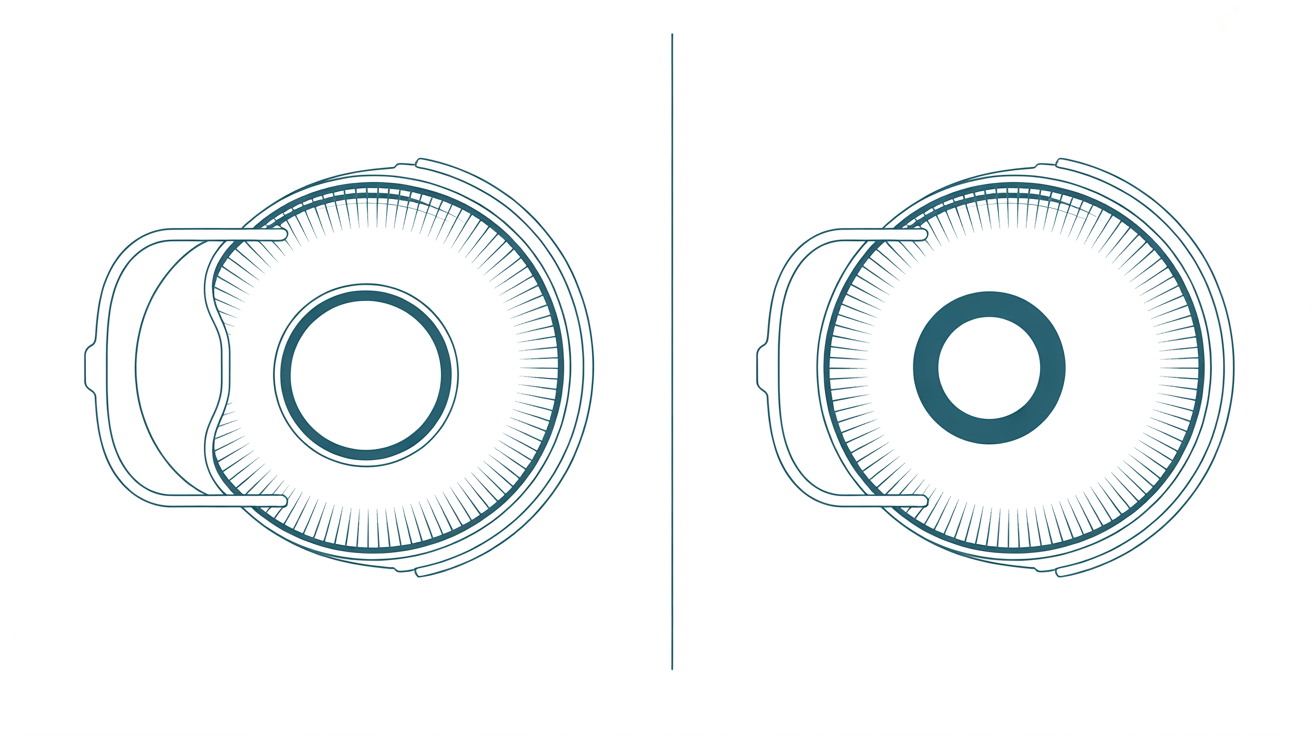
A plus lens loses effective power as it moves onto the cornea, so the ordered contact lens is stronger in plus than the glasses Rx. A +4.00 D spectacle lens at 12 mm becomes +4.20 D before rounding and +4.25 D after. +6.00 D becomes +6.47 D unrounded and +6.50 D rounded. +10.00 D becomes +11.36 D unrounded, +11.25 D at the manufacturing step. Ordering a +6.00 D contact lens for a +6.00 D spectacle Rx leaves the eye under-plussed at the corneal plane.
How do you apply vertex to each toric meridian?
Apply vertex to each toric meridian by converting both principal powers, then reconstructing SPH and CYL; axis is unchanged.
- Write the axis meridian as the sphere, and the meridian 90° away as sphere plus cylinder.
- Convert each meridional power with Fc = Fs ÷ (1 − d × Fs) at the stated vertex (default 12 mm).
- Reconstruct sphere from the first compensated meridian and cylinder as the second compensated meridian minus the first.
- Leave axis unchanged during vertex compensation.
- Round sphere and cylinder to the nearest 0.25 D.
Worked example at 12 mm: −5.00 −2.00 × 180, meridians −5.00 D and −7.00 D. Unrounded Fc is −4.72 D and −6.46 D; reconstructed starting parameters before rounding are −4.72 −1.74 × 180. After 0.25 D rounding the starting Rx is −4.75 −1.75 × 180. Axis stays 180. Vertexing the −5.00 D sphere alone leaves the −7.00 D meridian unconverted. That reconstruction is the published method, not a house rule: the National Academy of Opticianry course states that a compound Rx needs one computation per principal meridian, and that "the difference between the two compensated meridianal powers yields the power of the compensated cylinder". Manufacturer fitting calculators that apply 12 mm across each power meridian use the same per-meridian logic. This page does not map the result to a trial SKU.
Calculate a toric starting power on the Toric Contact Lens Calculator after both meridians are vertexed. That is the contact lens vertex calculator toric path: vertex here, then fit cylinder and axis there.
What is back vertex distance on a refraction?
Back vertex distance is the d in Fc = Fs ÷ (1 − d × Fs), measured from the spectacle-lens back surface to the cornea.
Phoropter vertex is about 13.75 mm. Trial frames run about 10 to 16 mm by fit and frame style. This calculator still defaults to 12 mm unless you enter a measured BVD. Use the measured value when you have one. The 12 mm default is a common clinical stand-in, not a claim that every phoropter sits at 12 mm. Deeper optics of why the plane change exists belong on Vertex Distance of Contact Lenses.
Patient aside (Grade 8 to 9)
Your glasses sit a little in front of your eye. A contact lens sits on the eye. That's why the two numbers differ. This calculator is not a mail-order prescription. A licensed fitter still puts a trial lens on and checks the power.
What is back vertex power on a contact lens order?
Back vertex power is power measured at the back surface of a lens: Fs is the back vertex power of the spectacle lens, and Fc is the starting back vertex power (BVP) of the contact lens.
A written spectacle Rx and a contact lens label both report back vertex power, which is why the two numbers look interchangeable and are not: they are quoted at planes about 12 mm apart. Vertex compensation is the step that moves the BVP from the spectacle plane to the corneal plane, so a back vertex power calculator and this vertex calculator run the same computation named from either end. The result above is the unrounded Fc and the 0.25 D starting BVP, a starting parameter until a fitter verifies it on eye.
What should you do after vertex compensation?
After vertex compensation, round to 0.25 D, treat the output as starting parameters, fit the trial lens, and verify with over-refraction. The following four steps are that sequence in order.
- Round Fc to the nearest 0.25 D manufacturing step.
- Treat the output as starting parameters, not a prescription.
- Fit the diagnostic or trial lens on eye.
- Verify power with over-refraction after the trial lens.
Rounding without a trial lens is still a paper number. Fitting without over-refraction leaves residual sphere or cylinder unmeasured. High powers and anisometropia make that residual obvious. Use the Over-Refraction Calculator for Contact Lens Parameters after the trial lens.
Verify with over-refraction after the trial lens.
Vertex calculator questions
How far do spectacle lenses sit from the cornea compared with a contact lens?
Spectacle lenses sit about 12 to 14 mm from the cornea; a contact lens sits on the cornea at essentially zero vertex.
That gap is the whole reason a contact lens vertex calculator exists. Glasses power and contact lens power share a label only when vertex compensation is negligible.
Does vertexing the sphere alone convert a toric spectacle Rx?
A toric spectacle Rx requires vertex compensation of each principal meridian before reconstructing sphere, cylinder, and axis.
Sphere-only vertexing leaves the second meridian at the spectacle plane. Cylinder is the difference between those meridians, so an unvertexed second meridian yields the wrong starting cylinder.
How do you read a CL vertex chart at 12 mm?
A CL vertex chart is a contact lens vertex chart: it lists starting contact lens power next to spectacle power at 12 mm in 0.25 D steps.
Find the spectacle meridian in the left column. Read the starting CL power and the change. For toric Rxs, look up each meridian, then rebuild SPH/CYL/AX. Use the calculator for a vertex other than 12 mm.
How is residual contact lens power vertexed after corneal refractive surgery?
Vertex compensation applies to the spectacle over-refraction for residual error, not to the corneal ablation.
Use the residual spectacle refraction as Fs. Apply the same ±4.00 D meridional gate. Do not vertex the surgical correction itself.
Why does this contact lens vertex calculator default to 12 mm?
12 mm is the site default when back vertex distance is unspecified.
Stokkermans and Day, in the StatPearls chapter Aniseikonia, state that the vertex distance "is generally close to 12 mm (0.012 m)", which is the same stand-in this calculator uses when none is entered. Override it for a known phoropter or trial-frame BVD. Brand fitting tools also use 12 mm per meridian for their own lenses. We keep the default and omit the SKU picker.
Does vertex compensation change powers under ±4.00 D?
Meridional powers below about ±4.00 D produce a vertex change under 0.25 D at 12 mm.
The ordered sphere often does not move a 0.25 D step on a gated converter. This page still always applies Fc, then rounds, so ±3.75 D at 12 mm can move a 0.25 D step here and not when you convert the rest of the spectacle Rx.
Starting contact lens parameters are not a prescription
Not a Rx
Not a prescription / on-eye next step
Starting contact lens parameters from this vertex calculation are not a prescription. Independent professional judgment still decides the ordered lens after on-eye fit. Educated patients who searched a vertex distance calculator do not self-prescribe from the chart or the Fc output.
Calculate vertex-compensated contact lens power, convert spectacle prescription to contact lens parameters, and keep those contact lens parameters at the corneal plane until a fitter verifies them. Read Starting Contact Lens Parameters Are Not a Prescription for the bound that applies across this site.
Sources
- Kollbaum PS, Bradley A, Thibos LN. Comparing the Optical Properties of Soft Contact Lenses On and Off the Eye. Optometry and Vision Science, 2013 (PMID 23969894) — peer-reviewed use of the plane-shift computation, described there as the method "commonly used in the clinical setting to 'vertex' a spectacle prescription to a contact lens prescription", written in reciprocal focal-length form. That form rearranges to Fc = Fs ÷ (1 − d × Fs). The paper's own shift is lens back vertex to pupil plane at 3 mm, not spectacle plane to cornea at 12 mm; only the identity is taken from it.
- Stokkermans TJ, Day SH. Aniseikonia. StatPearls, NCBI Bookshelf — vertex distance "is generally close to 12 mm (0.012 m)", the site's default when back vertex distance is unspecified.
- Drake DF. Vertex Distance, Effective Power, and Compensated Power — Tilt — Wrap. National Academy of Opticianry continuing-education course, approved by the American Board of Opticianry, 2016 — for contact lenses, all powers greater than 4.00 D in either principal meridian must be compensated; a compound Rx needs one computation per principal meridian; the compensated cylinder is the difference between the two compensated meridians. Its arithmetic shortcut (EP = D² ÷ 1000 × mm of change) is an approximation and is not what this calculator runs; its 14 mm dispensing default is a spectacle convention and is not this site's 12 mm contact lens default.
- Wikipedia, Vertex distance — general-reference statement of Fc = Fs ÷ (1 − d × Fs) and of its inverse; retained as a plain-language cross-check, not as the clinical authority.
- ODReference, Vertex Distance Calculator — independent practitioner calculator publishing the same 12 mm chart and 0.25 D steps; named as a cross-check and an alternative, not as a source of clinical authority.
Published Last updated Report a correction