What is the diameter of a contact lens?
The diameter of a contact lens is the width of the lens from edge to edge.
Lenstore, What is Base Curve and Diameter (13 November 2025) uses that edge-to-edge definition. LensWorld, Contact Lens Base Curve Diameter Explained (24 July 2024) states the same: diameter is the width of the lens, measured in millimeters. Pinnacle Eyecare (12 September 2025) defines diameter as the size of the lens from edge to edge. BellaLense, Contact Lens Sizes Guide describes DIA as the total width from one edge to the other. Feel Good Contacts (1 July 2024) states that diameter specifies overall size and, with base curve, determines how the lens fits. ContactsDirect states that diameter indicates size and is used to determine fit.
This page defines medical overall diameter — the ordered DIA on a contact lens prescription. Cosmetic search results sometimes treat “diameter” as how much a colored iris overlay covers the natural iris. That is a different query. Colored-lens and local-inventory tails are not this URL’s job.
How is diameter labeled on a box or prescription?
Diameter is labeled in millimeters as DIA.
According to Lenstore, you find BC and DIA on three labeled surfaces:
- The contact lens box
- The foil blister pack
- The contact lens prescription
1-800 Contacts, What Does Base Curve Mean for Contact Lenses (18 June 2024) states that BC and DIA are usually visible on the outside of the box, and gives a label example of BC: 8.7 DIA: 14 (base curve 8.7 mm, diameter 14 mm). That is a packaging example, not a universal pair.
Lenstore states that most soft contact lenses are manufactured with a fixed diameter, and that you typically cannot choose a different diameter unless a different lens brand is prescribed. Enter DIA exactly as written for that design.
What typical diameter ranges appear on soft contact lenses?
The following table lists soft-lens diameter ranges as stated by published sources. It is the contact lens size chart on this URL. It is not a brand catalog and not a PDF of SKUs.
| Source | Stated soft diameter range | Notes in that source |
|---|---|---|
| Lenstore, What is Base Curve and Diameter | Usually 13.80 mm–14.50 mm | 14.00 mm and 14.20 mm most common |
| BellaLense, Contact Lens Sizes Guide | Usually 13.8–14.5 mm for standard soft lenses | States that 14.0 mm and 14.2 mm dominate that retailer’s market copy |
| LensWorld, Contact Lens Base Curve Diameter Explained | Typically 13–15 mm | Relates diameter to iris size |
This page treats 13.80–14.50 mm with 14.00 mm and 14.20 mm commonly stated as the primary attributed window. LensWorld’s 13–15 mm band is wider. BellaLense’s 14.0 / 14.2 “dominate” sentence is retailer catalog copy, cited here as such, not as an independent clinical census.
This table plus on-eye fit is the contact lens size chart on this URL. It is not a shopping grid.
How do 14.0 mm and 14.2 mm diameters differ as fitting parameters?
14.0 mm and 14.2 mm diameters differ by 0.2 mm of overall lens size; they are not mail-order substitutes.
Lenstore names 14.00 mm and 14.20 mm as the most common soft sizes inside a usual 13.80–14.50 mm window. This page answers them as discrete fitted values.
DIA 14.2 on a label means an overall diameter of 14.2 mm. 14.5 mm sits at the top of Lenstore’s usual 14.50 mm bound and appears as another discrete size in retailer intros. The step from 14.2 mm to 14.5 mm is 0.3 mm of overall size, read on the same edge-to-edge measurement as the 0.2 mm step below it. This page does not name a clinical winner among 14.0, 14.2, and 14.5. Wrong diameter, in Lenstore’s copy, can affect comfort and visual stability. Fit is confirmed on eye for the brand actually trialed.
Do not substitute 14.0 for 14.2 because a listing was in stock or nearer. Lenstore: most soft designs fix diameter; a different DIA usually means a different prescribed brand.
How does visible iris diameter relate to contact lens diameter?
Horizontal visible iris diameter (HVID) is a corneal-size measurement that can flag when a stock soft diameter will not cover or center well.

According to EyesOnEyeCare (11 August 2023), average HVID is about 11.8 mm, and a patient whose corneal size falls outside 11.6 mm to 12.0 mm may be a good candidate for a custom soft lens. LensWorld states that contact lens diameter is determined by the size of the wearer’s iris. EyesOnEyeCare’s fit checks for a stock lens include three observations:
- The lens is well-centered
- The lens provides full coverage over the limbus
- The lens moves an appropriate amount for tear-film exchange
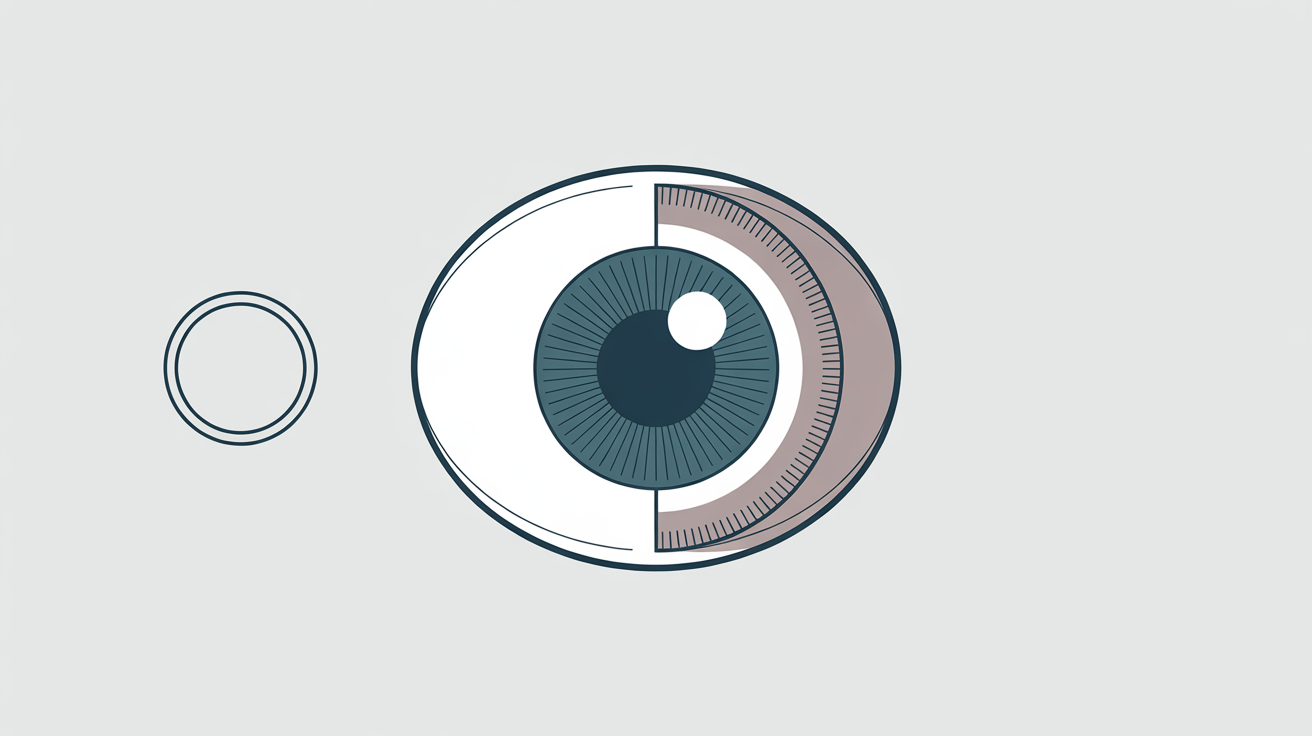
Worked example. HVID measures 11.4 mm — 0.2 mm below the lower edge of the EyesOnEyeCare 11.6 mm to 12.0 mm window and 0.4 mm under the 11.8 mm average that page states. The reading orders nothing on its own. What it says is that a stock diameter is now a parameter to check rather than assume, against the same three observations: centration, coverage over the limbus, and movement for tear exchange. A lens that fails them is the referral to a custom or specialty design, not a smaller number typed into a search box.
A smaller-eye fit is that HVID / coverage problem, not a 13.8 mm shopping aisle. BellaLense mentions smaller diameters around 13.8 mm in catalog language; this page does not adopt that as a petite-eye nomogram. If HVID sits outside the EyesOnEyeCare 11.6–12.0 mm window, the next step is a custom or specialty design, not a cart filter.
Why does spectacle conversion not produce a diameter?
Spectacle conversion does not produce a diameter because a glasses Rx contains power, not overall lens size.
According to Pinnacle Eyecare, a conversion chart cannot figure out base curve, diameter, or brand and material. Feel Good Contacts lists diameter among contact-only specifications. ODReference’s conversion calculator returns starting soft-lens power that still requires on-eye evaluation and decisions such as base curve, diameter, and material.
The Contact Lens Conversion Calculator calculates vertex-compensated starting power, optional spherical equivalent, and rounding. It does not output DIA. Calculate power there. Fit diameter here, on eye.
How do base curve and diameter work together on the eye?
Base curve and diameter work together because both change how the lens vaults and sits on the cornea.
Feel Good Contacts states that diameter, along with base curve, determines how the lens fits. EyesOnEyeCare states that changing diameter or BC between brands or designs may not change fit in a predictable fashion, given material, water content, and modulus. Lenstore states that the same printed base curve can still fit differently when material, thickness, and design differ; diameter is usually fixed per soft brand.
Sagittal depth is the name of that interaction in the site’s entity map: BC + DIA together, not BC or DIA in isolation. Read the Base Curve of Contact Lenses explainer for back-surface radius, steeper vs flatter polarity, and empirical flat-K bands. Do not swap one parameter from a catalog and keep the other from a different brand as if the pair still matched the trial lens.
What is optic zone diameter, and how does it differ from overall diameter?
Optic zone diameter is the central powered portion of the lens; overall diameter is the full edge-to-edge lens, and overall diameter is the DIA this page and a contact lens prescription state.
One lens carries two diameters. The DIA printed on a box, blister, or Rx — 14.0 mm, 14.2 mm — is the overall value, the one ordered. Inside that outline sits a smaller optic zone: the central area that carries the prescribed power. What lies outside it is peripheral geometry and edge, which position and move the lens rather than correct it. A query about optic zone diameter is asking after the inner number. Lens size, DIA, and the 13.80–14.50 mm window above are the outer one.
In rigid gas permeable designs both are ordered, and optic zone is chosen with base curve rather than after it. According to Contact Lens Spectrum, Rules of Thumb (Tony A.J. Phillips and Kristin Bailey, October 2024), a 0.50 mm change in back optic zone diameter (BOZD) historically required a 0.05 mm change in back optic zone radius (BOZR) to hold the same central fluorescein pattern. That article states the rule is only partially correct and is a guide, not a scientifically exact engine. Move one number and the fitting relationship evaluated on eye is no longer the one being ordered.
A soft lens order names overall DIA; the manufacturer fixes the optic zone inside the design, which is why Lenstore describes soft diameter as fixed per brand. The GP treatment — BOZR and BOZD as a pair, peripheral curves, and fluorescein reading — is on the RGP Contact Lens Parameters and Starting Power guide. Optic zone diameter is a design parameter a fitter selects and verifies on eye. It is not a value a spectacle Rx converts into.
When should diameter change instead of power on a toric lens?
Unstable toric rotation is addressed by changing base curve, diameter, or design before optical compensation.
According to ODReference’s cross-cylinder page, optically compensating a lens that will not stabilize is a moving target. Cross-cylinder math assumes the next lens rotates the same way. Change geometry first. Calculate starting SPH, CYL, and AX on the Toric Contact Lens Calculator. You still fit a starting toric or multifocal contact lens on eye.
Starting contact lens parameters still require on-eye fit
Starting contact lens parameters still require on-eye fit because converted power plus a printed DIA is not a finished prescription.
Lenstore states that a diameter that is too small or too large can affect comfort and visual stability. Pinnacle lists blur, strain, dryness, and discomfort among poor-fit risks. Those are chairside problems. They are not solved by ordering 14.2 mm because a search result called it common.
Patient aside (Grade 8–9)
The number on a glasses Rx is not your contact lens diameter. An eye-care practitioner measures the eye, tries a lens, and writes DIA with base curve and power. Do not swap 14.0 for 14.2 because a box was in stock.
Read Starting Contact Lens Parameters Are Not a Prescription for the bound that applies across this site. Convert spectacle prescription to contact lens parameters for power. Fit diameter on eye with base curve. Verify power with over-refraction after the trial lens. Contact lens parameters at the corneal plane stay unfinished until that sequence is done.
Sources
Claims on this page are attributed to the publications below, and the class of each source is worth stating plainly. Four of the five are consumer or retailer explainers. They are cited for one narrow job — what DIA means on a box, blister, or listing, and which catalog widths those listings quote — and for nothing else. No fitting judgment on this site rests on a retail listing.
The geometry that decides whether a diameter fits is sourced from the professional literature on the pages that own it: Sagittal Depth of Contact Lenses for what a diameter does to vault over a stated chord, Peripheral Curves and Edge Lift of GP Contact Lenses for how overall diameter and the peripheral system divide up a rigid lens, and Scleral Lens Sizes: Corneoscleral, Mini-Scleral, and Full for the landing-zone case.
- Lenstore, What is Base Curve and Diameter— edge-to-edge width; DIA on box, blister, and prescription; usual soft diameter 13.80–14.50 mm with 14.00 mm and 14.20 mm most common; most soft designs fix diameter.
- BellaLense, Contact Lens Sizes Guide— DIA as total width; usual 13.8–14.5 mm; 14.0 mm and 14.2 mm as retailer catalog sizes; smaller diameters around 13.8 mm in catalog language.
- LensWorld, Contact Lens Base Curve Diameter Explained— diameter as width in millimeters; typically 13–15 mm; relates diameter to iris size.
- 1-800 Contacts, What Does Base Curve Mean for Contact Lenses— BC and DIA on the box; example BC: 8.7 DIA: 14.
- Contact Lens Spectrum, Rules of Thumb (Tony A.J. Phillips and Kristin Bailey, October 2024) — a 0.50 mm back optic zone diameter change historically required a 0.05 mm back optic zone radius change to hold the same central fluorescein pattern; stated there as a partially correct guide, not an exact engine.
Published Last updated Report a correction